

SECTION 1: When Paper Claims Outpace Physical Assets
“Bank Runs” Aren’t Just for Banks Anymore
In a traditional bank run, depositors discover their claims (deposits) far exceed the bank’s reserves (cash).
This mechanism isn’t unique to banking.
In January 2021, retail traders discovered that hedge funds had shorted more GameStop shares than actually existed, setting the stage for a historic “short squeeze.”
The story went viral and retail investors piled in, causing the price to surge from $20 to $483 over just 2 weeks. This left short sellers facing a catastrophic delivery problem:
They had sold claims to shares they couldn’t deliver.
Then Robinhood changed the rules mid-game, halting buying but not selling, giving hedge funds a chance to cover their bets at retail investors’ expense.
Nine months earlier, in April 2020, the price of oil went negative for the first time in history.
West Texas Intermediate crude settled at -$37.63 per barrel. That’s negative $37, in other words:
Sellers paid buyers to take oil off their hands: the contract to own oil had become more toxic than the oil itself.
Forty years earlier, in January 1980, the Hunt Brothers had cornered one-third of the world’s tradable silver supply.
To stop the squeeze, COMEX – the primary U.S. metals futures exchange – rewrote the rules overnight: raising margins, slashing position limits, and banning new long positions.
As a result, silver crashed 50% in a single day.
The same pattern played out with nickel on the London Metal Exchange in 2022 – except this time, the exchange simply deleted $12 billion in executed trades.
Different markets, different decades, same mechanism:
When paper claims collide with physical reality, the system doesn’t fail gracefully. Someone always ends up holding the bag (and it’s never the exchange).
In 1991, a comedian became an unwitting prophet of this mechanism at the heart of global finance.
Jerry Seinfeld & The Car Reservation (That Explains Global Finance)
In Season 3, Episode 5 of Seinfeld, Jerry has a confirmed reservation for a rental car.
When he arrives at the counter, the agent informs him they’ve run out of cars.
SCENE: Seinfeld at the Rental Counter
JERRY: I made a reservation for a mid-size.
AGENT: I’m sorry, we have no mid-size available at the moment.
JERRY: I don’t understand – I made a reservation. Do you have my reservation?
AGENT: Yes, we do. Unfortunately, we ran out of cars.
JERRY: But the reservation keeps the car here. That’s why you have the reservations.
AGENT: I know why we have reservations.
JERRY: I don’t think you do. If you did, I’d have a car. See, you know how to take the reservation. You just don’t know how to hold the reservation. And that’s really the most important part of the reservation, the holding. Anybody can just take ’em.
Of course, the Agent has no response. How could they?
But it’s much deeper than sitcoms & rental cars:
Jerry unknowingly diagnosed the entire global financial system.
Taking the reservation is the Paper Layer – the world of claims: database entries, confirmation numbers, contracts, derivatives. It’s frictionless and infinitely scalable. The rental agency can issue a thousand reservations in an hour because creating claims costs nothing.
Holding the reservation is the Physical Layer – the world of assets: actual cars, finite parking lots, real inventory. It’s constrained by atoms, space, and logistics. You can’t conjure a car with a database update. You have to own it, store it, and keep it unavailable to everyone else.
The Paper Layer scales exponentially. The Physical Layer scales linearly.
The gap between these two layers – Paper and Physical, Claims and Assets – is where the Vanishing Collateral Problem lives.
When Claims multiply faster than Assets, multiple ‘owners’ exist on paper until everyone tries to take delivery at once.
Then you discover who actually owns it.
This architecture is operating at scale across every major market.
Claims vs Assets in 2026: The Leverage Ratios Nobody Talks About
These ratios aren’t hypothetical edge cases:
It’s the operating system of global finance.
Consider the leverage ratios across major asset markets, organized by the type of claim:
Not all leverage works the same way. Some claims are direct bets against physical inventory sitting in a vault. Some are constrained by the infrastructure required to move the asset. And some create risk not through delivery failure but through the chain of counterparties standing between you and your asset.
The distinction matters because each type breaks differently under stress.

Direct Delivery Claims
Is the physical thing actually in the vault? These are claims measured directly against registered, deliverable inventory.
- Silver: ~7x open interest vs. registered COMEX inventory. Coverage ratio at 14%, meaning registered vaults could satisfy roughly one in seven outstanding claims. Registered inventory fell 38% in four months between October 2025 and February 2026 – a structural drawdown, not a blip. (CME warehouse reports)
- Gold: ~8.6x open interest vs. registered inventory. Delivery rates have surged to 7% of open interest – seven times the pre-2020 baseline of less than 1%. COMEX is quietly transforming from a paper trading venue into a physical distribution hub. (CME delivery reports)
- Coffee: Ratio spiked to 200:1 at the November 2023 extreme. Even at typical levels, certified physical inventory is a fraction of outstanding contracts. (ICE)
Logistical & Infrastructure Claims
The asset exists, but can it get to you? These are claims where delivery is limited by the physical infrastructure required to move the asset under stress.
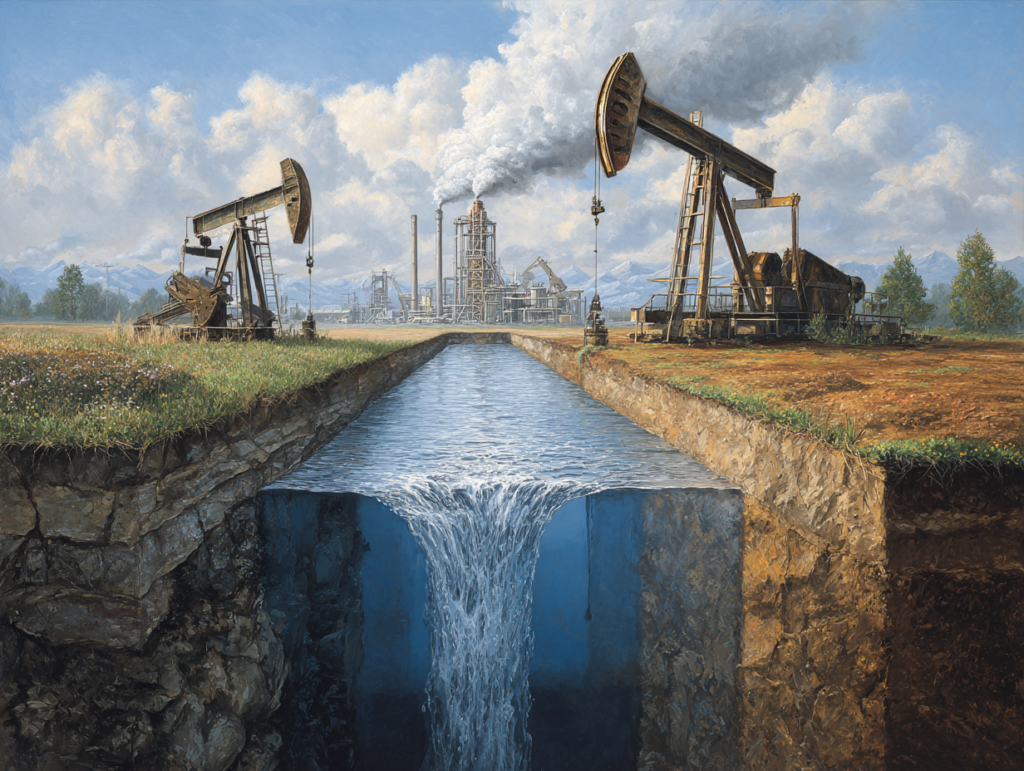
- Oil: ~27-31x open interest vs. deliverable Cushing storage capacity. April 2020 proved the binding constraint is storage, not production – WTI went to -$37.63 not because oil was worthless, but because there was nowhere left to put it. (CFTC, EIA)
- Natural gas: Less than 2% of futures contracts result in physical delivery. (EIA)
- Colorado River Water: Legal entitlements exceed physical flow by 33%; actual usage exceeds supply by 52%. (Congressional Research Service)

Systemic Claim Chains
You’re not betting on an asset. You’re betting that a chain of counterparties will honor their promises. These claims create risk not through delivery failure but through the cascade that follows when one link in the chain breaks.
- Interest rate derivatives: $846 trillion notional, but after legally enforceable netting, actual credit exposure compresses to ~$2.8 trillion – 0.3% of notional. The risk is counterparty chain failure, not delivery failure in the physical sense. If a major dealer defaults, the netting assumptions collapse, and gross exposure becomes relevant overnight. (BIS, June 2025)
- Treasury rehypothecation: The same bond pledged as collateral 6-7x across the chain, with hedge funds holding over $1 trillion in leveraged basis trades that depend on the recycling chain holding.
Everything Is Built on One Assumption
The mechanism operates in three distinct modes, but all three converge on the same structural fragility: claims exceed what the system can honor under stress.
Everything worth anything has already been borrowed against (many times over).
Every market operates on the same assumption:
“Not everyone will demand delivery at once.”
This used to be a risk unique to fractional reserve banking.
Now it’s the reality for practically every asset in every market.
The financial system has perfected the art of “taking reservations.” Creating claims costs nothing. Many entities get paid to create them.
The problems arise when it comes to “holding the reservation,” actually delivering the physical asset when conversion is demanded. Delivery fulfillment comes with real, hard costs, from storage, transportation, and labor, to insurance, security, and more.
So when does the gap become fatal?
Not all paper leverage is pathological.
A futures market where most participants are hedgers who never intend delivery can function at high paper-to-physical ratios indefinitely.
The ratio becomes dangerous at the point where forced delivery would require intervention to prevent systemic failure:
Where the system depends not on orderly settlement…
… but on nobody ever testing it.
This gap between Paper and Physical didn’t appear by accident: it’s how the system was designed.
It works, as long as the gap stays hidden.
But what happens when it doesn’t?

THESIS STATEMENT: The Vanishing Collateral Problem
We’ve built a world where the collateral backing trillions in claims doesn’t exist in deliverable form.
The system functions only as long as this fact stays ignored.
Claims exceed deliverable collateral by ratios of 7:1 to 200:1 across every major market. Most participants are swimming naked without realizing it… the tide just hasn’t gone out yet.
How did this gap grow so large? And what happens when the system breaks?
To understand, we’ll seek to answer three questions:
- How do claims multiply faster than assets?
- What prevents delivery when claims are called?
- How does the system hide the gap?
The answers will lead us to the Three Mechanisms of the Vanishing Collateral Problem.
SECTION 2: The Three Mechanisms of Vanishing Collateral
The research revealed three structural Mechanisms that inevitably lead to three systemic Problems.
- Mechanism #1. Paper Inflation (The Claim Multiplication Problem): Financial claims scale exponentially. Physical collateral scales linearly. The same asset backs multiple simultaneous claims.
- Mechanism #2. Delivery Failure (The Physics Problem): When delivery is demanded, infrastructure cannot absorb the velocity of claims. Theory meets reality, and reality loses.
- Mechanism #3. Settlement Intervention (The Governance Problem): When forced delivery would trigger cascade failure, the system will almost always act to protect itself, even when it means forcing a mid-game change to the rules.
These three Mechanisms operate identically across securities, Treasuries, oil, gold, real estate, even water, coffee, and more. The leverage ratios vary. The architecture of Vanishing Collateral does not.
Mechanism #1. PAPER INFLATION
One Asset, Six Owners?
Vanishing collateral begins with paper inflation: financial claims scaling faster than the physical stuff required to back them.
Currency is printed out of thin air. Derivatives are created with a few keystrokes. Rehypothecation chains multiply collateral across balance sheets.
Contracts roll forward indefinitely without ever resulting in physical settlement. A single asset can back six different balance sheets simultaneously, with each party believing they own the collateral.
Only when several claimants demand delivery at the same time do you discover who actually “owns” the underlying asset.
This isn’t efficiency. It’s systemic dependency masquerading as liquidity.
What If the “Safest” Asset Is Not So Safe?
U.S. Treasury bonds are the bedrock of the global financial system. Over $28 trillion in outstanding debt, backed by the full faith and credit of the United States government. They’re what every other asset is measured against.
The “risk-free rate” that underpins every mortgage, every corporate bond, every pension fund’s projections.
If there’s one asset you’d assume is exactly what it says on the label, it’s this one.
Unfortunately, that’s not the case.
The Treasury market recycles the same collateral 6 to 7 times over (rehypothecation). One bond gets pledged as collateral for a loan. The lender then pledges that same bond for their loan. And so on down the chain, until a single security is functioning as the ‘asset’ backing six or seven different transactions at once. Hedge funds have piled over $1 trillion into leveraged bets that depend on this recycling chain holding.
When this chain was tested in March 2020, it failed. The Fed was forced to purchase $1 trillion in Treasuries to prevent systemic collapse. We’ll map the full transmission later.
The simple takeaway is that even the so-called “safest” asset has secrets to hide.

When California Sold More Water Than It Had
California’s water rights system, which dates back to the Gold Rush, has handed out legal claims to 370 million acre-feet of water per year.
The problem: the state only produces about 70 million.
That’s a 5.3:1 leverage ratio, and it gets worse at the local level.
In the San Joaquin River Basin, allocations exceed natural flow by 8.6x.
These legal claims from the 1800s persist while physical hydrology shifts under climate pressure. Now the state is forcing a reckoning. One of the largest farming districts in the country, Westlands, has to cut its groundwater pumping in half by 2030. That’s the backstop supply farmers relied on when their surface water allocations hit zero, and it’s being taken away.
The system runs on a no-show assumption: not all rights holders will demand delivery simultaneously.
Drought exposed the assumption as fiction.
🗝️ The Key Question:
What Are You Actually Pricing?
Treasuries rehypothecated 6-7x.
Water allocated at 5.3:1.
Silver has a 14% coverage ratio.
At these levels, you’re no longer pricing the asset; you’re pricing the probability that not everyone demands delivery simultaneously.
At 50:1, you’re pricing the likelihood the system can defer settlement indefinitely.
At 200:1, you’re pricing consensus hallucination.
Mechanism #2. DELIVERY FAILURE
When Someone Actually Shows Up for the Car
Paper inflation stays invisible as long as nobody tests it.
The moment someone demands their car at the rental counter, the moment a claim holder actually says deliver, a different kind of failure takes over. Not a failure of math or modeling. A failure of atoms.
The infrastructure required to move real things can’t keep up with the claims demanding conversion.
If the asset cannot be delivered, stored, transported, or intermediated, price becomes irrelevant. The contract is toxic regardless of what the screen says.
Systems don’t fail at their averages. They fail at their brittle nodes.
Three Death Sentences for Delivery
Delivery failure shows up in three places. Each one is invisible until tested.
#1. Storage Hits Capacity.
Cushing, Oklahoma holds 76 million barrels of theoretical oil storage capacity. But you can never actually fill a tank to the top. Engineering constraints (the space oil needs to expand, residual oil that can’t be pumped out, structural limits on the tanks themselves) cap real-world capacity at around 85%.
By April 2020, Cushing hit 65 million barrels and 85% effective capacity. Pipelines were full, refineries had cut runs by 30%, and there was nowhere left to put incoming crude.
WTI didn’t go to -$37.63 because oil was worthless. It went negative because storage was scarcer than the commodity. The physical space to hold the reservation had run out.
The same constraint binds gold. COMEX registered inventory has fallen to roughly 10 million ounces while open interest exceeds 87 million ounces – an 8.6x ratio. If just 5% of paper holders demanded physical delivery simultaneously, registered inventory would be exhausted several times over. And most gold classified as “eligible” (technically available but not pledged for delivery) can disappear from the exchange at any moment with no obligation to remain.
#2. Movement Creates Bottlenecks.
In March 2020, international flights grounded worldwide. Gold was physically trapped on the wrong continent.
London’s standard bar is 400 ounces. COMEX delivery requires 100-ounce bars. Converting between them requires Swiss refineries. With flights grounded and refineries operating at reduced capacity, the arbitrage between London spot and COMEX futures, normally measured in pennies, blew out to $40-$100 per ounce.
The gold existed. The price was right. Delivery was impossible. The atoms couldn’t cross the ocean.
California’s water system faces the same physics in slow motion. The Sacramento-San Joaquin Delta conveyance system loses 30% of throughput to salinity management and ecosystem requirements. The infrastructure physically cannot move what legal allocations promise.
When drought hit and snowpack collapsed, even pre-1914 water rights, claims so senior they were considered absolute, were curtailed for the first time in history.
#3. Balance Sheets Max Out.
Twenty-four primary dealers manage the $12.6 trillion Treasury repo market. Their capacity to absorb bonds is capped not by willingness but by regulation.
Federal rules limit how much debt these dealers can hold on their books relative to their capital. So even when they have the cash and the appetite to buy, the law can say no.
March 2020 proved exactly how this fails. Hedge funds tried to sell Treasuries to meet margin calls. Dealers had the cash and the appetite, but their balance sheets were full. They refused to buy. The delivery infrastructure itself had hit capacity. The full cascade comes later.
The same regulatory architecture that froze Treasuries is reshaping gold. New international banking rules now penalize banks for holding paper gold on their books. The rule (Basel III’s Net Stable Funding Ratio) effectively charges banks 85 cents on every dollar of unallocated gold exposure they carry. Translation: the cheaper option is to either hold the physical metal or stop offering gold accounts entirely.
What this means for you: if you “own” gold through a bank’s unallocated account, the bank is being financially punished for holding your position. The regulatory architecture is compressing paper leverage, but it’s doing so by making delivery even harder, not easier.
🗝️ The Key Question:
Can You Actually Take Delivery?
Storage runs out. Movement chokes. Intermediaries hit capacity.
Every delivery failure shares the same root:
When claims collide with physical reality, the asset layer can’t keep up with the paper layer.
That was the same lesson of April 2020.
Professionals who understood where the physical exit was made money. Everyone who assumed price and deliverability were the same thing got destroyed.
Delivery failure is binary. It either clears, or it catastrophically fails. There is no graceful middle ground when physical constraints bind.
So what happens when a system at 50:1 or 200:1 leverage faces delivery failure across multiple asset classes simultaneously?
It should collapse. It doesn’t.
That’s where Settlement Intervention comes in.

Mechanism #3. SETTLEMENT INTERVENTION
When Someone Steps In and Changes the Rules
When delivery fails in a system leveraged 50:1, the math says it should detonate.
It doesn’t. Someone steps in and changes the rules.
This is not fraud. It is governance under stress.
Without intervention, systems at the leverage ratios documented in Mechanism #1 would collapse at the first serious delivery test. Intervention allows deferral instead of detonation.
The question isn’t whether intervention exists. It must exist. The question is what happens when intervention stops being the emergency exception and becomes the operating norm.
Go back to the examples from Section 1. Notice a pattern.
- GameStop, January 2021: Robinhood halted buying but not selling. Retail investors with executed orders couldn’t add to positions while institutional shorts covered. The stated reason was clearinghouse margin requirements. The margin applied to one side of the trade.
- LME Nickel, March 2022: Price spiked from $30,000 to $100,000 per ton as a short squeeze developed against a single Chinese producer. Forcing delivery would have bankrupted the short and exposed the exchange’s leverage. So LME cancelled nine hours of trading and retroactively voided $12 billion in completed transactions. Buyers who legally owned nickel at executed prices had their contracts erased.
- Hunt Brothers Silver, January 1980: COMEX raised margins 6x, slashed position limits by 80%, and banned all new long positions. Overnight. The rules of the game changed because the existing rules would have forced delivery that the system couldn’t honor.
- April 2020 WTI: CME allowed negative pricing for the first time in the exchange’s history, forcing contract holders to pay buyers to take delivery obligations. An improvised rule change to prevent a delivery failure from cascading into a clearing failure.
Every one of these interventions protected the system. Every one of them transferred losses from institutions to individuals.
Extend & Pretend: When Everyone Agrees Not to Look
Not all intervention is dramatic. Some of it is quiet enough to miss entirely.
Commercial real estate is the masterclass. In Q3 2024, $11.2 billion in CRE loans were modified rather than foreclosed. Interest capitalized instead of paid. Maturities extended without principal reduction. Loans split into “performing” and “loss-absorbing” tranches so the top slice stays clean on paper.
The buildings haven’t changed. The tenants haven’t returned. The loans haven’t been repaid.
But the books say “current.”
Appraisers use stale comps because transaction volume has collapsed. If nobody’s selling, nobody’s forced to mark to market. The 132 basis point gap between private appraisals (4.54% cap rates) and public REIT pricing (5.86%) implies 15-20% phantom valuation across the commercial real estate market. That gap persists because the system has collectively agreed not to test it.
The March 2020 basis trade unwind followed the same logic at institutional scale. Rather than force hedge funds to liquidate Treasury positions into a frozen market, the Fed created a $1 trillion repo facility allowing funds to post illiquid off-the-run bonds as collateral. Settlement was deferred and losses socialized. The positions survived.
Built to Be Blind: When Opacity Is the Product
The most powerful form of intervention isn’t changing the rules or extending the timeline.
It’s making sure nobody can see clearly enough to force the question.
London’s unallocated gold market is the clearest example. Banks market these accounts to customers as ownership. What the IMF actually classifies them as is unsecured credit. You think you hold metal. Your bank thinks it owes you a favor.
The distinction is invisible, until bankruptcy forces it into the open.
When MF Global collapsed in 2011, customer accounts labeled “segregated” were raided to cover proprietary trading losses. It took four years of litigation to recover 100% of funds. Unallocated gold holders would have even less protection.
Treasury markets operate behind similar fog.
- $1.4 trillion in Cayman-domiciled positions invisible to standard U.S. reporting
- $5 trillion in non-centrally cleared bilateral repo
- Rehypothecation chains that no single regulator maps end-to-end
You can’t measure risk you can’t see. And in this system, the inability to measure risk is a feature, not a bug.
If full transparency were imposed tomorrow, and every claim against every physical asset were mapped in real time, the system would face immediate forced convergence. Prices would collapse to reflect actual deliverable supply. Leverage would unwind violently.
Opacity doesn’t cause the gap between claims and collateral.
It prevents anyone from forcing the gap to close.
🗝️ The Key Question:
Do You Actually Own It?
There’s an old principle in finance, often associated with Paul Volcker: if you can’t understand the structure in ten minutes, someone’s hiding insolvency through complexity.
The red flags are consistent across every asset class:
- Sudden rule changes during stress
- Persistent price divergence without clearing
- Expected physical delivery quietly replaced by cash settlement
- Complexity that serves no purpose except to obscure the underlying leverage
When settlement becomes optional rather than mandatory, price stops being a binding contract and becomes informational at best.
And when intervention shifts from emergency exception to standard operating procedure, the nature of ownership itself changes.
You don’t own an asset. You own a claim the system may or may not honor when tested.

SECTION 3: How It All Breaks at Once
Shared Plumbing = Shared Points of Failure
Everything described in Section 2: paper inflation, delivery failure, settlement intervention… all of it was presented one asset class at a time. Treasuries here. Oil there. Gold over there.
That separation was a convenience for explanation, but it does not reflect reality.
The fact is:
All asset markets share the same plumbing.
Dealer balance sheets, margin requirements, repo markets, and regulatory capital rules connect asset classes that look independent on the surface.
- A margin call on an oil position…
- Forces a Treasury sale to raise cash…
- Tightening the repo market…
- That a gold carry trade depends on.
This is how a doom loop gets triggered: one domino rattles four markets before anyone has even mapped the connection.
In normal conditions, the coupling is invisible. In crisis, it’s the only thing that matters.
Correlation goes to 1.0… not because markets suddenly agree, but because they all rely on the same conversion & settlement infrastructure.
This isn’t theory. March 2020 proved it.

March 2020: The Multi-Asset Cascade
What most people remember about March 2020 is the pandemic. What almost nobody saw was what happened underneath it in financial markets:
A single shock hit five asset classes in sequence… and they all broke the exact same way.
The pandemic arrives and volatility explodes. Margin calls start cascading across every leveraged position in the system. The biggest ticking time bomb was something called the basis trade: hedge funds borrowing at 50x leverage to exploit tiny price gaps between Treasury bonds and Treasury futures. This widely used trade prints money in calm markets, but also happens to detonate the moment volatility spikes.
And from there, the dominoes began to fall.
Stage 1: The Trigger Event
(Treasuries Seize.)
Hedge funds need to sell bonds to meet margin, but the 24 primary dealers have hit their SLR balance sheet capacity and won’t absorb off-the-run Treasuries. Bid-ask spreads blow to 6x normal and market depth collapses to 10-38% of typical levels.
The 10-year yield spikes 64 basis points despite a deflationary shock. Yields should have fallen, but instead rose because delivery infrastructure was broken. Turns out the “risk-free” asset’s liquidity was an assumption nobody had tested at scale until everyone tested it at once.
Stage 2: The Fed Steps In.
(It Makes Things Worse.)
The Fed is forced to purchase $1 trillion in Treasuries to restore dealer capacity.
It works… for Treasuries.
But a trillion dollars doesn’t just sit still. Money markets flood with liquidity flowing outward, seeking yield, driving up commodity speculation.
The real economy has ground to a halt, while the financial system is flush with a trillion-dollar cash injection.
That money had to go somewhere.
Stage 3: Oil Storage Fills Up
(Prices Go Below Zero.)
Physical oil demand collapses as global lockdowns cut 20 million barrels per day, but financial positioning actually increases as speculators pile in.
Cushing storage fills toward its effective ceiling with pipelines full, refineries cutting runs 30%, and no egress anywhere.
On April 20, 2020, WTI crude settles at -$37.63, a historical first.
Contract holders pay buyers to take the delivery obligation. Retail traders via USO and Robinhood – holding 25% of May open interest without understanding physical settlement – are decimated.
Stage 4: Physical Gold Gets Trapped
(Paper Gold Doesn’t.)
International flights are grounded worldwide.
Gold becomes physically trapped on the wrong continent.
London’s standard 400-ounce bars can’t reach Swiss refineries for conversion to 100-ounce COMEX bars. With flights down and refineries at reduced capacity, the arbitrage between London spot and COMEX futures (normally measured in pennies) blows out to $40-$100 per ounce.
Paper gold kept trading on screens as if nothing had happened. Physical gold sat in vaults on the wrong continent.
For a few weeks, the market was forced to admit the Vanishing Collateral Problem Thesis:
Paper gold and physical gold are only the same asset as long as delivery isn’t demanded.
⚠️ Reality Check:
The Diversification Myth
Diversification works… for the risk it’s designed to handle. When one sector dips, another holds. When one company fails, your portfolio absorbs it. That’s idiosyncratic risk, and spreading your bets across uncorrelated assets is the textbook defense against it.
But March 2020 didn’t test idiosyncratic risk. It tested infrastructure risk. And infrastructure risk doesn’t care how many asset classes you spread across, because they all run on the same settlement plumbing: dealer balance sheets, margin systems, repo markets. A single pandemic event triggered conversion stress across Treasuries, oil, gold, equities, and corporate bonds – all within the same two-week window.
Diversification protects you when one asset fails. It does nothing when the conversion mechanism underneath all of them fails simultaneously. Your five “uncorrelated” assets were uncorrelated right up until the moment correlation was the only thing that mattered.
All five assets relied on the same assumption: that claims convert on demand. When that assumption broke, everything broke together.
You weren’t holding five different assets. You were holding five different flavors of the same bet.

The Engine That Guarantees It Happens Again
March 2020 wasn’t a one-off. The interventions that rescued it are the same ones guaranteeing the next version will be worse.
Every intervention documented in this piece – the Fed’s $1 trillion Treasury purchase, the LME’s $12 billion trade cancellation, Robinhood’s one-sided halt, the extend-and-pretend regime in commercial real estate – solved the immediate crisis. Every one. And every one of them taught the system the same lesson: leverage is safe because delivery will never be enforced.
Paper inflation creates fragility. Fragility produces crisis. Crisis triggers intervention. Intervention rewards the leveraged and punishes the cautious. Participants rationally increase leverage. Paper inflation accelerates.
That loop is the engine. Not a side effect. Not an accident. The permission structure.
Remove the interventions and the system corrects violently at low leverage. Keep them and the system corrects catastrophically at high leverage. Pick your poison. There is no version where it doesn’t correct.
The Fed purchased $1 trillion in Treasuries in 2020. What will the number be next time? And the time after that? Each cycle, the gap between claims and collateral grows wider. Each cycle, the required intervention grows larger.
Each successful rescue makes the next failure bigger.
What Will Trigger the Next Cascading Doom Loop?
You’ve seen the engine. Here’s what the next cycle could look like – not as prediction, but as mechanism illustration.
Insurance markets in California and Florida continue to deteriorate, which makes homes uninsurable, which collapses their value, which leaves regional banks holding mortgages on properties whose collateral just evaporated. That balance sheet damage forces deleveraging.
So the banks pull back from Treasury repo to preserve their SLR ratios. That spikes repo rates and blows out the carrying costs on basis trades. Hedge funds are forced to unwind, dumping cash Treasuries into the market just as dealer capacity shrinks. March 2020 redux. The Fed intervenes again. The moral hazard cycle deepens.
And while all of that is happening, the commercial real estate maturity wall grinds forward. Extend-and-pretend can’t hold forever. Forced price discovery collapses the appraisal gap. Phantom value evaporates. Bank capital takes another hit, tightening Treasury repo capacity even further.
The doom loop in full: real estate stress → bank balance sheets → Treasury market liquidity → basis trade stability → corporate bond spreads → equity volatility → margin calls → commodity positioning → storage and logistics constraints.
One crisis. Five assets. Same structural flaw. Same shared plumbing.
The worst part? You probably won’t see it coming.
⚠️ Reality Check:
The Price Discovery Myth
You’d think the price would warn you. That’s what markets are supposed to do: aggregate information and signal when something is wrong via price fluctuations.
But in a system built on leverage and opacity, price signals have become proxies for proxies.
- Water rights price on legal allocations, not actual supply.
- Gold prices on ETF flows, not delivery cost.
- Treasuries price on algorithms, not dealer capacity.
- Real estate prices on appraisals, not transactions.
Every major asset class prices on a proxy that works fine in normal trading… and violently disconnects from reality the moment physical delivery is tested.
When that moment comes, the proxy collapses and the real price is whatever someone will actually pay for an asset they can actually receive. The gap between those two numbers is where fortunes disappear.
When price discovery dies, markets don’t ever properly clear; they amplify delusion until physical reality forces painful correction.
The first person to force delivery discovers the reservation was never backed by a car.

SECTION 4: What Is Ownership, Really?
The Three-Question Ontological Audit for What You Own
Every asset in your portfolio deserves an ontological audit. This isn’t your typical spreadsheet exercise or financial model. It’s a series of questions designed to reveal what’s real, and what might just be an ownership illusion.
Question 1: What do I actually hold & control?
Your brokerage statement says one thing. The legal reality underneath it may say something very different. For every asset you hold, ask: what’s the gap between what I see on the screen and what I could actually claim in a crisis?
- Water: legal allocations vs. reliable supply
- Oil: paper barrels vs. daily production
- Gold: derivative exposure vs. physical holdings
- Treasuries: rehypothecation depth vs. unique bonds in existence
- Real estate: appraised value vs. what someone would actually pay in a transaction
In every case, the paper claim and the physical reality are two different numbers. Sometimes the gap is small. Sometimes it’s 200:1. There is no number where safety ends and danger begins. You’re looking for the gap between what’s promised and what exists. When that gap exceeds what deferral can hide, it closes violently.
⚖️ AUDIT APPLIED: Gold ETF Shares
What You Actually Own
You hold shares in GLD, the world’s largest gold ETF. Your brokerage statement says “gold.” But what do you actually own?
GLD shares represent claims on gold bars held in a trust, with HSBC as custodian in London vaults. The trust holds allocated gold – specific bars with serial numbers. In theory, those bars are yours. In practice, the trust uses subcustodians who may hold gold in unallocated form, and the prospectus limits the trust’s ability to oversee those arrangements. Your claim runs through a chain of intermediaries, each with its own rules and risks.
Your claim is one of many against a system of custody that’s also connected to other transactions you’ll never see. How many total claims ultimately touch the same physical bars? Nobody knows. Not even HSBC.
Question 2: If I need to sell this tomorrow, could I?
Forget normal conditions. The question is whether the infrastructure survives simultaneous demand.
- Storage: Is Cushing at 85%? Can COMEX vaults absorb a 5% delivery spike?
- Movement: Can the Delta conveyance system deliver what allocations promise? Can gold cross an ocean when flights ground?
- Intermediaries: Do the 24 primary dealers have balance sheet room? What happens to repo when SLR binds?
You’re not stress-testing price volatility. You’re stress-testing physics. Can the atoms move fast enough to honor the paper?
⚖️ AUDIT APPLIED: Gold ETF Shares
What Happens When You Try to Leave
Say you want to convert your GLD shares into physical gold. You can’t. Only “Authorized Participants” – a small group of large institutions – can redeem GLD shares for metal. Redemption requires baskets of 100,000 shares, roughly $50 million at current prices.
You’re locked out of delivery by design. The only exit is selling your shares on the secondary market to another buyer who also can’t take delivery.
If a crisis hits and everyone sells at once, the whole chain is just people trading claims on gold that none of them can get. The price of GLD and the price of physical gold can diverge – and in March 2020, they did.
Question 3: Am I protected if they change the rules?
When delivery fails and it looks like collapse is imminent, the system always steps in and changes the rules to protect itself (not you). Robinhood halted buying. The LME erased $12 billion in trades. COMEX banned new long positions overnight. Every intervention protected the system at the expense of individuals.
The question for your portfolio: if that happens to an asset you hold, what happens to your position?
Look for the warning signs:
- Cash settlement clauses that let the exchange pay you in dollars instead of delivering the asset
- Force majeure provisions that suspend normal rules during “extraordinary” conditions
- Fine print that reclassifies your ownership as unsecured credit
- Counterparty arrangements where the entity holding your asset can also use it for their own obligations
- Complexity in the custody chain that no single regulator oversees end-to-end
The deeper problem is that most of this is invisible by design. If full transparency would crash the system, ask yourself who benefits from the fog. Ask yourself why the data you’d need to answer these questions doesn’t exist in any public database.
You’re not calculating risk. You’re asking whether risk is calculable at all.
⚖️ AUDIT APPLIED: Gold ETF Shares
What the Fine Print Won’t Tell You
Your GLD shares? They’re securities, not gold. They represent an interest in a trust that holds allocated bars. That’s better than an unallocated bank gold account, which the IMF classifies as unsecured credit – meaning if the bank fails, you’re a creditor in line, not an owner of metal. Your GLD shares sit in a different legal category. But both share the same fundamental vulnerability: multiple layers between you and the metal, each with its own failure mode.
When MF Global collapsed in 2011, customer accounts labeled “segregated” were raided to cover proprietary trading losses. Four years of litigation to recover funds. And those were segregated accounts – the highest tier of protection available. The fine print of what you “own” is hidden behind language engineered to make credit look like custody. A securities lawyer could decode the prospectus for you. Most of what they’d find, you were never meant to see.
Run those three questions against anything you hold. The answers won’t sort your portfolio into “safe” and “unsafe.” They’ll do something more valuable: they’ll show you what each position actually depends on.

Your Portfolio in a Post-Collateral World
The three questions don’t produce a verdict. They surface dependencies.
And every asset has them.
- Physical gold – no counterparty, but you still can’t eat it, and it’s priced in a currency with its own Vanishing Collateral dynamics.
- Real estate – your title depends on an insurance company, your value depends on a functioning mortgage market, and your liquidity depends on a buyer who can get financing.
- Treasuries – a Treasury held directly at TreasuryDirect carries different dependencies than one held through a prime brokerage, which carries radically different dependencies than one rehypothecated six times through a dealer chain.
Every asset. Completely different set of assumptions holding it together.
The GLD audit showed what happens when all three questions point the same direction. Every layer of “ownership” rested on a different assumption, and none of them had been stress-tested at scale. Now you know what your position depends on: a chain of intermediaries, custodians, and legal structures that have never been tested under the kind of stress this piece documents.
The honest output of the three questions is awareness, not panic. You can decide whether you’re being compensated for carrying that risk. Most people never get that far. They carry the risk without knowing it exists.
The Concentration You Can’t See
Most people miss the deeper pattern: which of their holdings depend on the same infrastructure.
- Your Treasuries and your ETFs share settlement plumbing
- Your real estate and your bank deposits both depend on federal solvency assumptions
- Your brokerage positions all route through the same handful of primary dealers
When you run the three questions across a full portfolio, the pattern that emerges isn’t “these assets are safe and those aren’t.” It’s “these four holdings that look independent all break if the same thing breaks.”
Diversification by asset class can mask total dependency on shared infrastructure. That’s the structural risk. But the human risk is simpler.
Who Will Be Swimming Naked When the Tide Goes Out?
Warren Buffett’s famous line is usually quoted as a warning about leverage. It’s deeper than that. The tide going out doesn’t just reveal who borrowed too much. It reveals who didn’t understand what they were holding.
You can hold physical gold and still be swimming naked if your real estate, your business income, and your bank deposits are all exposed to the same shock.
The tide doesn’t sort assets by type. It sorts people by awareness. Those who’ve asked the questions know where their assumptions concentrate. Those who haven’t will find out in real time, alongside everyone else, when the next March 2020 hits.

Ownership Is a Question, Not a Statement
We’ve built a financial system where ownership is unknowable, risk can’t be measured, and settlement has become optional.
Most people don’t see it that way. They look at a brokerage statement and see a fact. A deed in a drawer. A number on a screen. Mine.
It isn’t. Ownership is a question. And the answer changes depending on who else is asking.
Why Nobody Has Fixed This
The obvious problem is transparency. If every claim against every physical asset were mapped in real time, the gap between paper and reality would be visible to everyone. You’d think someone would build that.
Nobody has. And the reasons aren’t simple.
- Self-interest. Some stakeholders benefit directly from the opacity. Every dollar of leverage generates fees. Every layer of complexity protects a balance sheet. But reducing this to greed misses the deeper problem.
- Fragmentation. Some regulators lack the jurisdiction. Rehypothecation chains cross borders, legal systems, and reporting frameworks that were never designed to talk to each other. Some market participants have tried to build better infrastructure and discovered that the coordination problem alone (getting counterparties, exchanges, and regulators across dozens of countries to agree on a shared standard) may be harder than the engineering.
- The catch-22. Full transparency under current leverage ratios would itself trigger the crisis everyone is trying to prevent. If every claim were made visible tomorrow, prices would collapse to reflect actual deliverable supply. Leverage would unwind violently.
The system’s opacity isn’t just a byproduct; it’s built-in to the foundations.
So the gap persists. And each crisis makes it worse. Intervention rewards the leveraged and punishes the cautious. Participants rationally increase leverage (if the Fed will backstop Treasuries, why not borrow more against them?). The cycle deepens.
When water rights collapse, farmers lose land they’ve worked for generations. When commercial real estate implodes, taxpayers backstop bank failures. When Treasury markets seize, dollar holders pay through Fed intervention. The gains stay private. The losses go public. Every time.
This will not reform itself from the top.
What You Can Actually Do About It
The system isn’t broken. It’s working exactly as designed.
Paper claims scale because creating them is cheap, and someone is getting paid every time one is created. Physical assets don’t scale because atoms are stubborn. There’s no shortcut to materialize a gold bar or office building.
The gap between the Paper Layer and the Physical Layer grows until someone tests it. And when tested, the system will act to protect itself, not you.
That cycle continues because the opacity holding it together is load-bearing. Nobody who benefits from it has the incentive, the jurisdiction, or the ability to change it without triggering the very crisis they’re trying to prevent.
That’s why the Three-Question Ontological Audit can give you what the system won’t: clarity on your own exposure.
What do I actually hold & control? If I need to sell this tomorrow, could I? Am I protected if they change the rules?
Start with your own portfolio. Ask the questions that most others are systematically blind to. Know the difference between what you actually own and can control, versus what you’re hoping someone else will honor.
The tide will go out. It always does. And every time it does, the cost of being wrong about what you own gets more expensive.